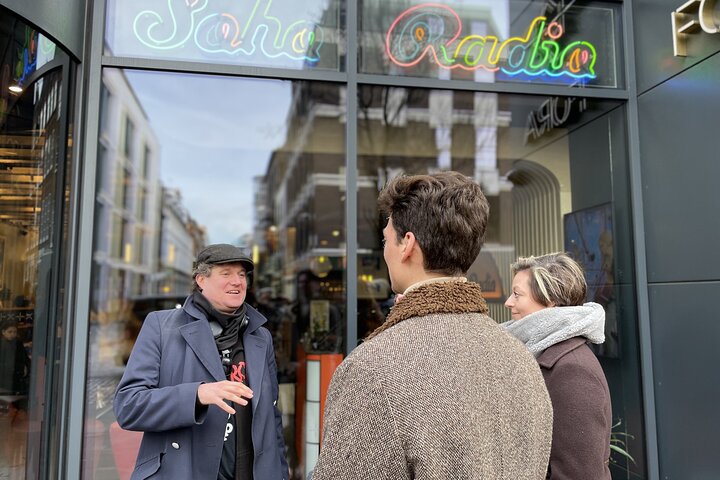
Full-Day Private Spirit of London Black Cab Tour
Traveler rating
5.0/5
Based on 1 traveler reviews. Ratings and reviews provided by Viator and Tripadvisor.
Quick answer
Is Full-Day Private Spirit of London Black Cab Tour worth booking?
Full-Day Private Spirit of London Black Cab Tour is a 8-hour experience in London, United Kingdom, from $1,484 per person. It scores 37 out of 100 on the Outty Ranking, which we label “Worth a Look”, based on a 5/5 rating across 1 reviews. This booking is non-refundable, so pick your date carefully. Same-day spots are currently showing.
- Outty Ranking
- 37 / 100
- Rating
- 5/5 (1)
- Duration
- 8 hours
- From
- $1,484 per person
This tour is a fascinating tour of London in an iconic black cab, where you will be able to learn about the history of black cabs in London. This is a very good attraction for first-time visitors. This specially designed full-day tour is exclusively dedicated for the first time visitors in London. Our tour can start various times in the morning depending on your request. The direction of the tour can be reversible. In this tour, we aim to give the full history of London in 8 hours. This way visitors can understand the 2000 years of history of the city. Our black cabbie guides have an excellent background of the city's history and we would be very pleased to offer an immaculate culture experience for our guests. We welcome the large group of travellers as well. Please just contact our tour management service for multiple London black cabs.. Here, the Spirit of London Tour ends with you taking wonderful memories of your tour of London in an iconic black cab, home with you.
What you get
About this experience
This tour is a fascinating tour of London in an iconic black cab, where you will be able to learn about the history of black cabs in London. This is a very good attraction for first-time visitors. This specially designed full-day tour is exclusively dedicated for the first time visitors in London. Our tour can start various times in the morning depending on your request. The direction of the tour can be reversible. In this tour, we aim to give the full history of London in 8 hours. This way visitors can understand the 2000 years of history of the city. Our black cabbie guides have an excellent background of the city's history and we would be very pleased to offer an immaculate culture experience for our guests. We welcome the large group of travellers as well. Please just contact our tour management service for multiple London black cabs.. Here, the Spirit of London Tour ends with you taking wonderful memories of your tour of London in an iconic black cab, home with you.
What's included
Included
- Bottled water
- In-vehicle air conditioning
- Surcharges on fuel
- Snacks
- Parking fees
- Ride on iconic London Black cab
Not included
- Gratuities
- Lunch
What you'll see and do
Houses of Parliament
The Houses of Parliament, known also as the Palace of Westminster is where the two Houses of the Parliament of the United Kingdom (the House of Lords and the House of Commons) conduct their sittings. They lie on the north bank of the River Thames in the London borough of the City of Westminster, close by other government buildings in Whitehall. The oldest part of the building is still in existence, Westminster Hall, which dates from 1097.The palace originally served as a royal residence, but no monarch has lived in it since the 16th century. Most of the present Houses of Parliament structure dates from the 19th century, when the Palace was rebuilt after it was almost entirely destroyed by a fire in 1834. The architects responsible for rebuilding the Palace was Sir Charles Barry and Augustus Welby Pugin, and the building is an example of the Gothic revival.
10 minutes here · Admission not included
Westminster Abbey
Westminster Abbey is a Church, burial ground, coronation site and much more and continues to attract visitors over 900 years after its founding. In many respects the architecture is common. There's the traditional cross-shaped floor plan with a nave, north and south transepts and several round side areas but both its execution and use raise The Collegiate Church of St Peter, Westminster (the official name) to among the highest examples of church construction. Here at Westminster Abbey lie buried kings and poets, scientists and philosophers who have themselves raised humankind to the highest levels. Isaac Newton and James Clerk Maxwell (discoverer of electromagnetic theory, which later lead to radio and TV), Chaucer and Kipling, Dr. Samuel Johnson (creator of the first English dictionary) and many other justly famous names are interred here.
10 minutes here · Admission not included
Parliament Square
Located right in the middle of London's iconic landmarks such as Houses of Parliament, Elizabeth Tower (a.k.a Big Ben), Whitehall, Saint-Margaret's Church, Westminster Abbey and Westminster Bridge. Parliament Square houses eleven state figures and world leaders, including Sir Winston Churchill, Gandhi and Nelson Mandela. Parliament Square in London is a popular destination among tourists. The atmosphere is magnificent and it's one of the must-visit locations in the city.
10 minutes here
10 Downing Street
Being one of the most important political buildings in the world, the United Kingdom's “White House”, Number 10 continuously hosts the British prime ministers since 1735. The main decisions affecting Britain's destiny in the last 275 years have seriously been taken behind its iconic black door. Today it's not possible to enter the street as a tourist but knowing the idea that an actual prime minister lives and works in the street is exhilarating.
5 minutes here · Admission not included
Buckingham Palace
Buckingham Palace is still the official residence of Britain's monarchy, as it has been since Queen Victoria's designation in 1837. Much of Buckingham Palace was constructed as early as 1703 for the Duke of Buckingham. Buckingham House (as it was then known) was purchased in 1762 by George III, who used it as a private residence. Over the following 75 years, the house was expanded to form three wings around a central courtyard. When Queen Victoria discovered Buckingham Palace lacked several 'necessary' rooms - such as a formal ballroom, a nursery, visitor's bedrooms and others - major additions were undertaken, including adding an entire wing to form a quadrangle. The Marble Arch was moved to Hyde Park, where it still resides near Speaker's Corner. With the re-facing using Portland stone in 1913, the palace received its last major change. Buckingham Palace is still actively used as both residence and offices, over 50,000 guests and invited diplomats to visit per year who interact with over 400 individuals for whom this is 'the office'. Nevertheless, several parts of Buckingham Palace are open to the public.
10 minutes here · Admission not included
Changing of the Guard
The Queen's Guard and Queen's Life Guard (called King's Guard and King's Life Guard when the reigning monarch is male) are the names given to contingents of infantry and cavalry soldiers charged with guarding the official royal residences in the United Kingdom. The British Army has regiments of both Horse Guards and Foot Guards predating the English Restoration (1660), and since the reign of King Charles II these regiments have been responsible for guarding the Sovereign's palaces. Despite tourist perceptions, the Guards are not purely ceremonial and are fully operational soldiers.
45 minutes here
St. James's Park
St. James's Park is one of the Royal Parks of London in the City of Westminster just east of Buckingham Palace and west of Downing Street. For more than four hundred years, St James ' Park has been the centre of the royal and ceremonial life of the country. Many features of the park have been shaped by Royal ambitions and national events. We will show hidden gems and the best spots for your best photo shots in the park.
25 minutes here
Trafalgar Square
Trafalgar Square is London's iconic public square in the City of Westminster built around the area formerly known as Charing Cross. Its name commemorates the Battle of Trafalgar, a British naval victory in the Napoleonic Wars over France and Spain that took place on 21 October 1805 off the coast of Cape Trafalgar. The site of Trafalgar Square had been a significant landmark since the 13th century and originally contained the King's Mews. After George IV moved the mews to Buckingham Palace, the area was redeveloped by architect John Nash, but progress was slow after his death, and the square did not open until 1844. The 169-foot (52 m) Nelson's Column at its centre is guarded by four lion statues. A number of commemorative statues and sculptures occupy the square, but the Fourth Plinth left empty since 1840, has been host to contemporary art since 1999. The square has been used for community gatherings and political demonstrations, including Bloody Sunday in 1887, the culmination of the first Aldermaston March, anti-war protests, and campaigns against climate change. A Christmas tree has been donated to the square by Norway since 1947 and is erected for twelve days before and after Christmas Day. The square is a centre of annual celebrations on New Year's Eve but the London Eye obviously stole the thunder of Trafalgar Square since the Millenium. It was well known for its feral pigeons until their removal in the early 21st century. Here we can observe the National Gallery, architect Sir James Gibbs's masterpiece St Martin in the Fields Church and National Portrait Gallery.
30 minutes here
The Lord Moon Of the Mall
No trip is complete without a traditional English pub visit in England. In London, the beer flows like the River Thames. Just look around. You are always near a pub. There are almost 7000 pubs in our city. The pub is a traditional public place to see and be seen for all Londoners. It’s just like a community centre. Pub, short for public house, is a British invention so too is “happy hour” a term from William Shakespeare. If you think that beer is the main drink in London pubs, that’s a mistake. For centuries there is another popular drink for Londoners. The traditional G&T which means gin and tonic. G&T might be distinctly British, but it was born in India. There are very important stories behind this sophisticated drink. What could be better than sipping while listening to the stories of traditional drinks in a traditional English pub.? We invite you to have this quintessentially British experience in the heart of London. What’s more? Of course, indulging yourself with pub classics such as Victorian recipe ale battered fish and chips and traditional Tudor recipe steak and ale pie. If you are vegetarian no problem. British classics like cauliflower cheese or grilled vegetables are just for you. It’s a been-there-done-that thing in our culture and you can’t just miss this.
45 minutes here
Covent Garden
Speaking of gardens, be sure not to overlook Covent Garden. It is associated with the former fruit-and-vegetable market in the central square, now a very popular shopping and tourist site. Not really gardens at all, the area is a spectacular array of theatres, shops (many people visit London just for the shopping) and more where the street performers compete with restaurants, bars, clubs and shops for tourists' attention. Covent Garden is also the prime destination of theatregoers and patrons of the Royal Opera House by night. It’s right situated in the heart of London’s Broadway West End. The area wasn’t used to be a fancy part of the city, however, series of developments after 70’s made this district as a prime destination of the tourists. Indeed, Covent Garden is one of the vibrant places of interests in London. It plays a great role in today’s cultural life with its theatres, restaurants, cafes, street performers, stalls, markets and many attractions. It’s a must-see place in London.
30 minutes here
Piccadilly Circus
At the junction of Regent Street and Shaftesbury Avenue lies a trapezoidal area near London's West End known to the world as Piccadilly Circus. It's an odd name since there's no circus there, but even odder is that 'circus' usually denotes around city area where several streets meet in a circle, after the Roman plan. But that eccentricity fits Piccadilly Circus since this area of the great British capital attracts the most diverse set of people in an already diverse town. The first half of the Piccadilly Circus name comes from a 17th-century frilly collar called a "picadil". The name is a perfect description, for here are the frills of London. Here are pubs, monuments, shops and nearby theatre in the West End. Yes, Piccadilly Circus, akin to New York's Times Square, it's filled with traffic, crowds and (mainly at night) neon lights befitting its role as a major tourist attraction. Known already by 1743 by its current name, the junction was created in 1819 and its history shows. There's the bronze Shaftesbury memorial fountain, erected in 1893, topped by a statue of Anteros, the Angel of Christian Charity. (The Evening Standard uses a graphic of the nude statue on its masthead.) Technologically innovative at the time, it was the first sculpture to be cast in aluminium. In the late 1980s, the fountain was moved from the centre to its present Piccadilly Circus location at the south-west corner of the intersection. Let Tourope UK's APTG qualified blue badge tourist guides introduce you the Times Square of our city.
Westminster Bridge
Westminster Bridge is not an ordinary bridge to span the river Thames. It has a very tumultuous history in London. The bridge's colour is green and the story of the bridge is colourful. We will tell you about the history of the bridge after Lady Boudicca's role in London's 2000-year-old history. Oh before we leave we will walk along the bridge and take pictures of London Eye, Royal Festival Hall and the River Thames.
10 minutes here
St. Paul's Cathedral
St Paul's Cathedral is a cathedral on Ludgate Hill, in the City of London, and the seat of the Bishop of London. The present building dates from the 17th century and is generally reckoned to be London's fourth St Paul’s Cathedral, although the number is higher if every major medieval reconstruction is counted as a new cathedral. The first cathedral was built of wood by the Saxons. It burned down in AD 675 and was rebuilt, again in wood, ten years later. After this version was sacked by the Vikings in 962, the "second" St Paul’s was built, this time mainly in stone. The predecessor to Wren's cathedral, the third St Paul’s (known as Old St Paul’s), was begun by the Normans after the late Saxon cathedral suffered in a fire of 1087. Work took over two hundred years, and a great deal was lost in a fire in 1136. Nonetheless, the roof was once more built of wood, which was ultimately to doom the building. St Paul is the symbol of a nation's resistance. We have plenty of stories to tell about Sir Christopher's masterpiece in the heart of London.
15 minutes here · Admission not included
The Monument to the Great Fire of London
The Monument to the Great Fire of London, more commonly known simply as the Monument, is a Doric column situated near the northern end of London Bridge. Commemorating the Great Fire of London, it stands at the junction of Monument Street and Fish Street Hill, 202 feet (62 m) in height and 202 feet west of the spot in Pudding Lane where the Great Fire started on 2 September 1666. Constructed between 1671 and 1677, it was built on the site of St. Margaret's, Fish Street, the first church to be destroyed by the Great Fire. The Monument comprises a fluted Doric column built of Portland stone topped with a gilded urn of fire. It was designed by Christopher Wren and Robert Hooke. Its height marks its distance from the site of the shop of Thomas Farriner (or Farynor), the king's baker, where the blaze began. Hear the story of how London missed its opportunity to be a highly planned city of all times.
5 minutes here · Admission not included
Tower Bridge
Tower Bridge is probably the city's most distinctive symbol of today. The Bridge shows a lot to its medieval predecessor London Bridge with its starlings and elaborate twin towers that give the bridge its name but it's not just a homage to the past, hidden inside that medieval-looking exterior there's a rather wonderful piece of Victorian engineering and in its day it was the biggest and most sophisticated lifting bridge in the world. Unlike London Bridge, the genius of the design is that the bridge can act as a gateway swinging open to allow tall ships to pass through. We will tell you plenty of things about this masterpiece in London, just follow us!
10 minutes here · Admission not included
Tower of London
Few prisons can claim to be as popular as the Tower of London, an attraction - unpleasant for some - for over 900 years. Its twenty towers are filled with an ancient tradition of royal blood, armor and jewels and the history to match. The Tower of London central structure began as a fort - used by the original builder William the Conqueror who completed the first tower around 1100 AD. At its completion it was the tallest building in London. Henry III had it whitewashed in the 13th century and the name, White Tower, has stuck. Later it evolved into a prison, used by Henry VII (and many others). Still later - and continuing to this day - it has acted as a repository for the extensive collection of crown jewels. Henry VII, nearly always short of money, had few jewels to store. But the stone complex, near the Tower Bridge alongside the River Thames, has also been used at various times to house the Royal Mint, the Public Records, the Royal Menagerie (later to form the starting point of the London Zoo) and an observatory (built in 1675). Listen to the rest of the story of the Tower of London from us today.
30 minutes here · Admission not included
St. Katharine Docks
St Katharine Docks is a former dock and now a mixed-use district in Central London, in the London Borough of Tower Hamlets and within the East End. It lies on the north bank of the River Thames, immediately downstream of the Tower of London and Tower Bridge. From 1828 to 1968 it was one of the commercial docks that made up the Port of London. It is in the redevelopment zone known as Docklands and is now a popular housing and leisure complex full of offices, public and private housing, a large hotel, shops and restaurants, an 18th century hidden gem in this yachting marina and other recreational facilities. It remains a popular leisure destination where you can enjoy and admire. Just follow us. Here we will have our lunch!
30 minutes here
Where it starts and ends
Hotel pickup
Pickup is included for all travelers. Pickup begins about 5 minutes before departure.
Before you book
- Cancellation
- All sales are final. No refund is available for cancellations.
- Languages
- de, ru, sk, en, it, pl, fr, tr, es
- Ticket
- Mobile Only
- Runs on
- Every day
- Group size
- Up to 15 travelers per booking
- Operated by
- Tourope UK
Know before you go
- Service animals allowed
- Public transportation options are available nearby
- Infants and small children can ride in a pram or stroller
- All areas and surfaces are wheelchair accessible
- Transportation options are wheelchair accessible
- Wheelchair accessible
- Travelers should have at least a moderate level of physical fitness
Photos


Traveler reviews
1 verified traveler reviews for Full-Day Private Spirit of London Black Cab Tour. Ratings and reviews provided by Viator and Tripadvisor.
Amazing experience! Got our moneys worth!
Amazing day with Julia! We covered all the major landmarks in the London area! She was very informal and fun to be around! We will definitely book again when we return!
via Tripadvisor
Good to know
- Duration
- 8 hours
- Free cancellation
- Non-refundable
- Minimum age to book
- All ages
- Availability
- Bookable today
- Runs on
- Every day
- Hotel pickup
- Included for all travelers
- Booked in 30 days
- 0
- Verdict
- Worth a Look
Who runs this experience
Operated by Tourope UK, who run 150 experiences we rank across 2 cities, with an average Outty Ranking of 38.1.
See everything Tourope UK runsWhy this scores 37
The Outty Ranking is a weighted composite. Here is how this experience performed on each component.
Full-Day Private Spirit of London Black Cab Tour: questions travelers ask
Practical detail on this experience, plus the wider planning questions for London.
How much does Full-Day Private Spirit of London Black Cab Tour cost?
+
Prices start at $1,484 per person. The final price depends on the date, the time slot and the number of travelers, and peak weekends in London usually price higher than midweek mornings. Live pricing and remaining availability are confirmed on the booking screen before you pay.
How long does Full-Day Private Spirit of London Black Cab Tour take?
+
Plan for about 8 hours from start to finish, not counting travel to the meeting point. Most travelers leave another 30 minutes on either side so the rest of the day in London is not rushed.
Is Full-Day Private Spirit of London Black Cab Tour worth it?
+
It holds an Outty Ranking of 37 out of 100, which we label "Worth a Look". That score blends traveler sentiment (5/5 across 1 reviews), the depth of that review evidence, recent booking momentum, value for money against comparable culture & history in London, and how flexible the cancellation terms are.
Can I cancel or reschedule Full-Day Private Spirit of London Black Cab Tour?
+
No. This experience is sold on a non-refundable basis, so only book a date you are confident about. Similar experiences in the city do offer free cancellation if flexibility matters more than price.
Is Full-Day Private Spirit of London Black Cab Tour suitable for kids and families?
+
Yes, all ages are welcome. Families should still weigh the 8-hour running time, and strollers are easier on the earlier, quieter departures.
How far in advance should I book Full-Day Private Spirit of London Black Cab Tour?
+
Around 0 people booked this in the last 30 days, so popular slots go early. Two to three weeks ahead is comfortable in shoulder season, while summer weekends and holidays in London can sell out a month out. Same-day spots do open up when other travelers cancel, so it is worth checking if you are already in town.
What should I bring or wear?
+
Bring photo ID, your booking confirmation on your phone, a refillable water bottle and comfortable shoes. Dress for the weather in London and add a light layer if any part of the 8-hour experience runs outdoors or after sunset.
Where does Full-Day Private Spirit of London Black Cab Tour start and how do I get there?
+
The exact meeting point and directions are on your voucher once you book, and they sit in central London within reach of public transport. Arrive 15 minutes early: late arrivals are treated as no-shows by most operators.
What are the best things to do in London?
+
London's best attractions split cleanly: the museums are free and need no booking, so the paid market is about views, theatre and getting out of the city for a day. That makes value scoring unusually important here, and the Outty Ranking penalises anything charging premium prices for access you could get for nothing. On Outty we rank every London experience on the same 0 to 100 scale, and alongside this one the highest scorers right now include The Great British Rock and Roll Walking Tour, Soho Music & Historic Pubs Tour, London Small Group Tour of Historical Pubs. The city page groups everything into most popular, highest reviewed, last minute and family-friendly so you can build a day around what actually delivers.
When is the best time to visit London?
+
May to September for long evenings, December for the Christmas markets. Booking patterns follow the same curve: prices and queues climb in peak weeks, while shoulder season gives you better availability on the top-ranked experiences and more room to change plans.
How many days do you need in London?
+
Three full days covers the headline sights without sprinting. A workable rhythm is one anchor experience each morning, such as this one, an unhurried afternoon in a single neighborhood, then a food or nightlife booking in the evening. Five days lets you add a day trip outside the city.
Do I book through Outty or through the operator?
+
Outty ranks and explains the experiences, then hands you to Viator to complete the booking with the operator directly. The price is the same as booking on Viator yourself, and Outty earns an affiliate commission on the referral, which is how the rankings stay free to read.
What is included in Full-Day Private Spirit of London Black Cab Tour?
+
Included: Bottled water; In-vehicle air conditioning; Surcharges on fuel; Snacks; and Parking fees. Not included: Gratuities; and Lunch. Always check the voucher for the final list before you travel.
Does Full-Day Private Spirit of London Black Cab Tour include hotel pickup?
+
Yes, pickup is offered for every traveler from 449 listed pickup locations in and around London. Be ready about 5 minutes before the start time. You can also enter a custom pickup address when booking.
What languages is Full-Day Private Spirit of London Black Cab Tour offered in?
+
It is offered in German, Russian, Slovak, English, Italian, Polish, French, Turkish and Spanish. Pick your language when choosing a date and time, as not every departure runs in every language.
Will I get instant confirmation and a mobile ticket for Full-Day Private Spirit of London Black Cab Tour?
+
Confirmation is sent by the operator after booking, usually within 48 hours; if it is not confirmed you are not charged. Mobile tickets are accepted, so you can show the voucher on your phone.
Is Full-Day Private Spirit of London Black Cab Tour wheelchair or stroller accessible?
+
The operator notes: Infants and small children can ride in a pram or stroller; All areas and surfaces are wheelchair accessible; Transportation options are wheelchair accessible; and Wheelchair accessible. If accessibility is critical, contact the operator after booking to confirm arrangements for your date.
What happens to Full-Day Private Spirit of London Black Cab Tour if the weather is bad?
+
It generally runs rain or shine, so dress for the forecast in London. Standard cancellation terms apply.
Ready to lock in your spot?
Pick a date, choose your group, and see the exact price for Full-Day Private Spirit of London Black Cab Tour.
Pick your date