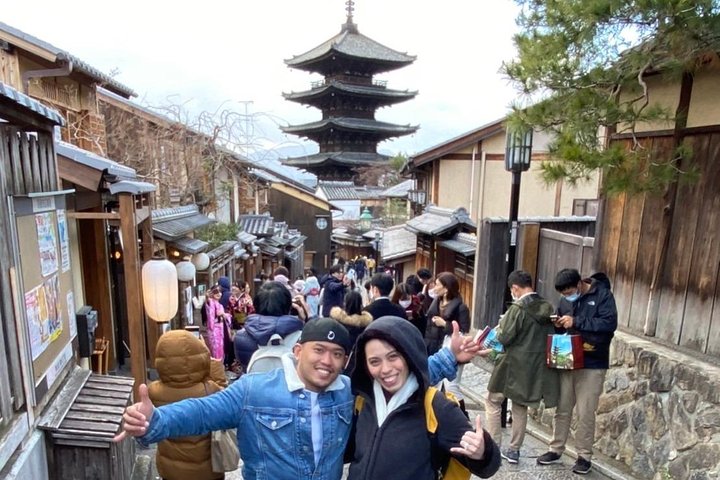
KYOTO Custom Tour with Private Car and Driver (Max 9 Pax)
Traveler rating
4.2/5
Based on 140 traveler reviews. Ratings and reviews provided by Viator and Tripadvisor.
Quick answer
Is KYOTO Custom Tour with Private Car and Driver (Max 9 Pax) worth booking?
KYOTO Custom Tour with Private Car and Driver (Max 9 Pax) is a 8-hour experience in Kobe, Japan, from $933 per person. It scores 54 out of 100 on the Outty Ranking, which we label “Worth a Look”, based on a 4.2/5 rating across 140 reviews. This booking is non-refundable, so pick your date carefully. Same-day spots are currently showing.
- Outty Ranking
- 54 / 100
- Rating
- 4.2/5 (140)
- Duration
- 8 hours
- From
- $933 per person
8-Hour Custom Tour with Private Car and Driver. Please select your most favorite sites in KYOTO and share with us your other special requests. We will help you plan the route, draft itinerary and make advanced reservations if necessary. VEHICLE We will arrange car for you based on the number of people in your group (maximum of 9 people). Our available cars are Land Rover Discovery, Toyota Alphard, HIACE and Grand Cabin. DRIVER The driver will drive and walk with you at most sites. However, there are some sites the driver cannot join you due to following reasons: 1.) some drivers need to take a rest/break at least 1 site during the tour 2.) when the parking lot is full especially during peak seasons 3.) where it is difficult to park/too pricy to park ... REMARKS a.) You can always amend the itinerary even while traveling with the driver on the day b.) Extra charge will be applied for over time service, picking-up/dropping-off at Kansai International Airport (KIX)
What you get
About this experience
8-Hour Custom Tour with Private Car and Driver. Please select your most favorite sites in KYOTO and share with us your other special requests. We will help you plan the route, draft itinerary and make advanced reservations if necessary. VEHICLE We will arrange car for you based on the number of people in your group (maximum of 9 people). Our available cars are Land Rover Discovery, Toyota Alphard, HIACE and Grand Cabin. DRIVER The driver will drive and walk with you at most sites. However, there are some sites the driver cannot join you due to following reasons: 1.) some drivers need to take a rest/break at least 1 site during the tour 2.) when the parking lot is full especially during peak seasons 3.) where it is difficult to park/too pricy to park ... REMARKS a.) You can always amend the itinerary even while traveling with the driver on the day b.) Extra charge will be applied for over time service, picking-up/dropping-off at Kansai International Airport (KIX)
What's included
Included
- Private transportation
- Fuel Fees, Toll Fees, Parking Fees
- In-vehicle air conditioning
Not included
- Entrance Fees
- Accommodation Fees
- Meals (Breakfast, Lunch, Dinner...)
What you'll see and do
Arashiyama
TOGETSUKYO BRIDGE The Togetsukyo Bridge (lit. "Moon Crossing Bridge") is Arashiyama's most iconic landmark. It was originally built during the Heian Period (794-1185) and most recently reconstructed in the 1930s. The bridge looks particularly attractive in combination with the forested mountainside in the background. A riverside park with dozens of cherry trees is located just adjacent to the bridge. BAMBOO GROVES The walking paths that cut through the bamboo groves make for a nice walk or bicycle ride. The groves are particularly attractive when there is a light wind and the tall bamboo stalks sway gently back and forth. The bamboo has been used to manufacture various products, such as baskets, cups, boxes and mats at local workshops for centuries. OKOCHI SANSO VILLA This is the former villa of the popular actor Okochi Denjiro (1896-1962), located in the back of Arashiyama's bamboo groves. Okochi Sanso consists of several different gardens and buildings, including living quarters, tea houses and gates. The buildings can only be viewed from the outside. Admission includes matcha green tea with a snack. MONKEY PARK IWATAYAMA Located in the Arashiyama mountains, the entrance to the monkey park can be found just south of the Togetsukyo Bridge. After hiking uphill for about ten minutes, visitors will find an open area with over a hundred monkeys roaming freely. There are also nice views down onto the city. TENRYUJI TEMPLE Ranked among Kyoto's five great Zen temples, Tenryuji is the largest and most impressive temple in Arashiyama. Founded in 1339 at the beginning of the Muromachi Period (1338-1573), the temple is one of Kyoto's many UNESCO World Heritage Sites. In addition to its temple buildings, there are attractive gardens with walking paths. DAIKAKUJI TEMPLE Daikakuji is a temple of the Shingon sect of Japanese Buddhism. Formerly the residence of an emperor, the buildings were converted into a temple in 876. During its history the temple traditionally had members of the imperial family serve as the head priest. Beside the main temple buildings there is a large pond and a pagoda. SAGA SCENIC RAILWAY The Saga Scenic Railway runs seven kilometers from Arashiyama to nearby Kameoka, mostly alongside the pretty Hozu River. The trains travel at a maximum speeds of about 25 km/h during their 25 minute journey, so passengers can enjoy the scenery without it rushing by too quickly. HOZU RIVER BOAT TOUR Departing from near the JR Kameoka Station, the Hozu River Boat Tour is a leisurely two hour trip that takes passengers down the winding Hozu River to the Togetsukyo Bridge. The trip passes by the forested mountainsides along the river. The boats seat 25 people and are heated in the winter. CORMORANT FISHING (UKAI) The Hozu River in Arashiyama is one of about a dozen rivers in Japan where ukai, a traditional fishing methods using cormorants, is practiced from July until late September. Tourists can observe the action from paid sightseeing boat cruises or from ashore. Cruises depart from the boat pier near the Togetsukyo Bridge.
90 minutes here · Admission not included
Kinkakuji Temple
Kinkakuji (Golden Pavilion) is a Zen temple in northern Kyoto whose top two floors are completely covered in gold leaf. Formally known as Rokuonji, the temple was the retirement villa of the shogun Ashikaga Yoshimitsu, and according to his will it became a Zen temple of the Rinzai sect after his death in 1408. Kinkakuji was the inspiration for the similarly named Ginkakuji (Silver Pavilion), built by Yoshimitsu's grandson, Ashikaga Yoshimasa, on the other side of the city a few decades later. Kinkakuji is an impressive structure built overlooking a large pond, and is the only building left of Yoshimitsu's former retirement complex. It has burned down numerous times throughout its history including twice during the Onin War, a civil war that destroyed much of Kyoto; and once again more recently in 1950 when it was set on fire by a fanatic monk. The present structure was rebuilt in 1955. Kinkakuji was built to echo the extravagant Kitayama culture that developed in the wealthy aristocratic circles of Kyoto during Yoshimitsu's times. Each floor represents a different style of architecture. The first floor is built in the Shinden style used for palace buildings during the Heian Period, and with its natural wood pillars and white plaster walls contrasts yet complements the gilded upper stories of the pavilion. Statues of the Shaka Buddha (historical Buddha) and Yoshimitsu are stored in the first floor. Although it is not possible to enter the pavilion, the statues can be viewed from across the pond if you look closely, as the front windows of the first floor are usually kept open. The second floor is built in the Bukke style used in samurai residences, and has its exterior completely covered in gold leaf. Inside is a seated Kannon Bodhisattva surrounded by statues of the Four Heavenly Kings; however, the statues are not shown to the public. Finally, the third and uppermost floor is built in the style of a Chinese Zen Hall, is gilded inside and out, and is capped with a golden phoenix. After viewing Kinkakuji from across the pond, visitors pass by the head priest's former living quarters (hojo) which are known for their painted sliding doors (fusuma), but are not open to the public. The path once again passes by Kinkakuji from behind then leads through the temple's gardens which have retained their original design from Yoshimitsu's days. The gardens hold a few other spots of interest including Anmintaku Pond that is said to never dry up, and statues that people throw coins at for luck. Continuing through the garden takes you to the Sekkatei Teahouse, added to Kinkakuji during the Edo Period, before you exit the paid temple area. Outside the exit are souvenir shops, a small tea garden where you can have matcha tea and sweets (500 yen) and Fudo Hall, a small temple hall which houses a statue of Fudo Myoo, one of the Five Wisdom Kings and protector of Buddhism. The statue is said to be carved by Kobo Daishi, one of the most important figures in Japanese religious history.
40 minutes here · Admission not included
Fushimi Inari-taisha Shrine
Fushimi Inari Shrine (Fushimi Inari Taisha) is an important Shinto shrine in southern Kyoto. It is famous for its thousands of vermilion torii gates, which straddle a network of trails behind its main buildings. The trails lead into the wooded forest of the sacred Mount Inari, which stands at 233 meters and belongs to the shrine grounds. Fushimi Inari is the most important of several thousands of shrines dedicated to Inari, the Shinto god of rice. Foxes are thought to be Inari's messengers, resulting in many fox statues across the shrine grounds. Fushimi Inari Shrine has ancient origins, predating the capital's move to Kyoto in 794. While the primary reason most foreign visitors come to Fushimi Inari Shrine is to explore the mountain trails, the shrine buildings themselves are also attractive. At the shrine's entrance stands the Romon Gate, which was donated in 1589 by the famous leader Toyotomi Hideyoshi. Behind stands the shrine's main hall (honden) where visitors should pay respect to the resident deity by making a small offering. At the very back of the shrine's main grounds is the entrance to the torii gate-covered hiking trail, which starts with two dense, parallel rows of gates called Senbon Torii ("thousands of torii gates"). The torii gates along the entire trail are donations by individuals and companies, and you will find the donator's name and the date of the donation inscribed on the back of each gate. The cost starts around 400,000 yen for a small sized gate and increases to over one million yen for a large gate. The hike to the summit of the mountain and back takes about 2-3 hours, however, visitors are free to walk just as far as they wish before turning back. Along the way, there are multiple smaller shrines with stacks of miniature torii gates that were donated by visitors with smaller budgets. There are also a few restaurants along the way, which offer locally themed dishes such as Inari Sushi and Kitsune Udon ("Fox Udon"), both featuring pieces of aburaage (fried tofu), said to be a favorite food of foxes. After about a 30-45 minute ascent and a gradual decrease in the density of torii gates, visitors will reach the Yotsutsuji intersection roughly half way up the mountain, where some nice views over Kyoto can be enjoyed, and the trail splits into a circular route to the summit. Many hikers only venture as far as here, as the trails do not offer much variation beyond this point and the gate density decreases further.
40 minutes here
Kiyomizu-dera Temple
Kiyomizudera (literally "Pure Water Temple") is one of the most celebrated temples of Japan. It was founded in 780 on the site of the Otowa Waterfall in the wooded hills east of Kyoto, and derives its name from the fall's pure waters. The temple was originally associated with the Hosso sect, one of the oldest schools within Japanese Buddhism, but formed its own Kita Hosso sect in 1965. In 1994, the temple was added to the list of UNESCO world heritage sites. Kiyomizudera is best known for its wooden stage that juts out from its main hall, 13 meters above the hillside below. The stage affords visitors a nice view of the numerous cherry and maple trees below that erupt in a sea of color in spring and fall, as well as of the city of Kyoto in the distance. The main hall, which together with the stage was built without the use of nails, houses the temple's primary object of worship, a small statue of the eleven faced, thousand armed Kannon. Other structures on the spacious temple grounds include the Okunoin Hall, which resembles the main hall on a smaller scale and has also a stage. Near the Okunoin are halls dedicated to Shaka Buddha (the historical Buddha) and Amida Buddha, as well as a small hall with nearly 200 stone statues of Jizo, the protector of children and travelers. The three-storied Koyasu Pagoda stands among the trees in the far southern end of the temple grounds, and a visit is said to bring about an easy and safe childbirth. Around the entrance of Kiyomizudera, outside the paid area, stand various other temple buildings, including a vermilion three storied pagoda, a repository for sutras, large entrance gates and the Zuigudo Hall which is dedicated to Buddha's mother and where against a small entrance fee you can wander the pitch black basement that symbolizes a mother's womb.Behind Kiyomizudera's main hall stands Jishu Shrine, a shrine dedicated to the deity of love and matchmaking. In front of the shrine are two stones, placed 18 meters apart. Successfully finding your way from one to the other with your eyes closed is said to bring luck in finding love. You can also have someone guide you from one stone to the other, but that is interpreted to mean that an intermediary will be needed in your love life as well. The Otowa Waterfall is located at the base of Kiyomizudera's main hall. Its waters are divided into three separate streams, and visitors use cups attached to long poles to drink from them. Each stream's water is said to have a different benefit, namely to cause longevity, success at school and a fortunate love life. However, drinking from all three streams is considered greedy. Part of the fun of visiting Kiyomizudera is the approach to the temple along the steep and busy lanes of the atmospheric Higashiyama District. The many shops and restaurants in the area have been catering to tourists and pilgrims for centuries, and products on sale range from local specialties such as Kiyomizu-yaki pottery, sweets and pickles to the standard set of souvenirs. The Higashiyama district together with Kiyomizudera, Yasaka Shrine and other temples in the area, have special evening illuminations during the annual Hanatoro event held in mid March. Kiyomizudera also has special illuminations during the autumn leaf season in the second half of November.
60 minutes here · Admission not included
Gion
Gion is Kyoto's most famous geisha district, located around Shijo Avenue between Yasaka Shrine in the east and the Kamo River in the west. It is filled with shops, restaurants and ochaya (teahouses), where geiko (Kyoto dialect for geisha) and maiko (geiko apprentices) entertain. Gion attracts tourists with its high concentration of traditional wooden machiya merchant houses. Due to the fact that property taxes were formerly based upon street frontage, the houses were built with narrow facades only five to six meters wide, but extend up to twenty meters in from the street. The most popular area of Gion is Hanami-koji Street from Shijo Avenue to Kenninji Temple. A nice (and expensive) place to dine, the street and its side alleys are lined with preserved machiya houses many of which now function as restaurants, serving Kyoto style kaiseki ryori (Japanese haute cuisine) and other types of local and international meals. Interspersed among the restaurants are a number of ochaya (teahouses), the most exclusive and expensive of Kyoto's dining establishments, where guests are entertained by maiko and geiko. Another scenic part of Gion is the Shirakawa Area which runs along the Shirakawa Canal parallel to Shijo Avenue. The canal is lined by willow trees, high class restaurants and ochaya, many of which have rooms overlooking the canal. As it is a little off the beaten path, the Shirakawa Area is typically somewhat quieter than Hanami-koji Street. Many tourists visit Gion hoping to catch a glimpse of a geiko or maiko on their way to or from an engagement at an ochaya in the evenings or while running errands during the day. However, if you spot a geiko or maiko, act respectfully. Complaints about tourists behaving like ruthless paparazzi are on the increase in recent years. The ultimate experience is being entertained by a maiko or geiko while dining at an ochaya. As expert hostesses, maiko and geiko ensure everyone's enjoyment by engaging in light conversation, serving drinks, leading drinking games and performing traditional music and dance. The services of geiko are expensive and exclusive, traditionally requiring an introduction from an existing customer. In recent years, however, some travel agencies and hotels have started to offer lunch or dinner packages with a maiko to any tourist with a sufficient budget. There are even a few companies which target foreign tourists without Japanese language skills. A more accessible experience is the cultural show held everyday at Gion Corner at the end of Hanami-koji. Aimed at foreign tourists, the show is a highly concentrated introduction to several traditional Japanese arts and include short performances of a tea ceremony, ikebana, bunraku, Kyogen comic plays and dances performed by real maiko. If you are in Kyoto in April, check out the Miyako Odori with daily dance performances by maiko. Shijo Avenue, which bisects the Gion district, is a popular shopping area with stores selling local products including sweets, pickles and crafts. Gion is also known for the Gion Matsuri, the most famous festival in Japan. Ironically, the most spectacular events of the festival are held outside of Gion on the opposite side of the Kamo River. A visit to Gion is best combined with a stroll through the nearby Higashiyama District between Yasaka Shrine and Kiyomizudera. This area has more preserved streets and traditional shops selling all kinds of local foods, crafts and souvenirs.
30 minutes here
Sanjusangendo Temple
Sanjusangendo (Sanjūsangendō) is the popular name for Rengeo-in, a temple in eastern Kyoto which is famous for its 1001 statues of Kannon, the goddess of mercy. The temple was founded in 1164 and rebuilt a century later after the original structure had been destroyed in a fire. Measuring 120 meters, the temple hall is Japan's longest wooden structure. The name Sanjusangendo (literally "33 intervals") derives from the number of intervals between the building's support columns, a traditional method of measuring the size of a building. In the center of the main hall sits a large, wooden statue of a 1000-armed Kannon (Senju Kannon) that is flanked on each side by 500 statues of human sized 1000-armed Kannon standing in ten rows. Together they make for an awesome sight. 1000-armed Kannon are equipped with 11 heads to better witness the suffering of humans and with 1000 arms to better help them fight the suffering. Note that the actual statues have only 42 arms each. Subtract the two regular arms and multiply by the 25 planes of existence to get the full thousand.
40 minutes here · Admission not included
Ginkakuji Temple
Ginkakuji (Silver Pavilion) is a Zen temple along Kyoto's eastern mountains (Higashiyama). In 1482, shogun Ashikaga Yoshimasa built his retirement villa on the grounds of today's temple, modeling it after Kinkakuji (Golden Pavilion), his grandfather's retirement villa at the base of Kyoto's northern mountains (Kitayama). The villa was converted into a Zen temple after Yoshimasa's death in 1490. As the retirement villa of an art obsessed shogun, Ginkakuji became a center of contemporary culture, known as the Higashiyama Culture in contrast to the Kitayama Culture of his grandfather's times. Unlike the Kitayama Culture, which remained limited to the aristocratic circles of Kyoto, the Higashiyama Culture had a broad impact on the entire country. The arts developed and refined during the time include the tea ceremony, flower arrangement, noh theater, poetry, garden design and architecture. Today, Ginkakuji consists of the Silver Pavilion, half a dozen other temple buildings, a beautiful moss garden and a unique dry sand garden. It is enjoyed by walking along a circular route around its grounds, from which the gardens and buildings can be viewed.
60 minutes here · Admission not included
Nishiki Market Shopping District
Nishiki Market (Nishiki Ichiba) is a narrow, five block long shopping street lined by more than one hundred shops and restaurants. Known as "Kyoto's Kitchen", this lively retail market specializes in all things food related, like fresh seafood, produce, knives and cookware, and is a great place to find seasonal foods and Kyoto specialties, such as Japanese sweets, pickles, dried seafood and sushi. Nishiki Market has a pleasant but busy atmosphere that is inviting to those who want to explore the variety of culinary delights that Kyoto is famous for. The stores found throughout the market range in size from small narrow stalls to larger two story shops. Most specialize in a particular type of food, and almost everything sold at the market is locally produced and procured.
60 minutes here
Kyoto Imperial Palace
The Kyoto Imperial Palace (Kyōto Gosho) used to be the residence of Japan's Imperial Family until 1868, when the emperor and capital were moved from Kyoto to Tokyo. It is located in the spacious Kyoto Imperial Park (Kyōto Gyoen), an attractive park in the center of the city that also encompasses the Sento Imperial Palace and a few other attractions. The current Imperial Palace was reconstructed in 1855 after it had burnt down and moved around town repeatedly over the centuries. The complex is enclosed by long walls and consists of several gates, halls and gardens. The enthronement ceremonies of Emperors Taisho and Showa were still held in the palace's main hall. Tokyo Imperial Palace is now used for enthronement ceremonies.
60 minutes here
Nijo Castle
Nijo Castle was built in 1603 as the Kyoto residence of Tokugawa Ieyasu, the first shogun of the Edo Period (1603-1867). His grandson Iemitsu completed the castle's palace buildings 23 years later and further expanded the castle by adding a five story castle keep. After the Tokugawa Shogunate fell in 1867, Nijo Castle was used as an imperial palace for a while before being donated to the city and opened up to the public as a historic site. Its palace buildings are arguably the best surviving examples of castle palace architecture of Japan's feudal era, and the castle was designated a UNESCO world heritage site in 1994. Nijo Castle can be divided into three areas: the Honmaru (main circle of defense), the Ninomaru (secondary circle of defense) and some gardens that encircle the Honmaru and Ninomaru. The entire castle grounds and the Honmaru are surrounded by stone walls and moats.
60 minutes here · Admission not included
Eikando Zenrinji Temple
Eikando (永観堂, Eikandō), formally known as Zenrinji Temple, belongs to the Jodo sect of Japanese Buddhism. Located just north of the large temple complex of Nanzenji, Eikando is very famous for its autumn colors and the evening illuminations that take place in fall. The temple has a long history, and there are a variety of buildings and a pond garden that visitors can explore. A court noble of the Heian Period (710-1185) donated his villa to a priest, who converted it into a temple under the name Zenrinji (lit. "temple in a calm grove"). At its founding, Zenrinji was part of the Shingon sect and its first head priest was a disciple of the great Kobo Daishi, the sect's founder.
60 minutes here · Admission not included
Yasaka Shrine
Visit Yasaka Shrine (Gion Shrine) which is well known for its summer festival (the Gion Matsuri) which is celebrated every July. Gion Matsuri is the most famous festival in the whole country.
30 minutes here
Where it starts and ends
Meeting point
Kobe
we will contact clients via WhatsApp and inform them via WhatsApp
Meeting point
Kobe
we will contact clients via WhatsApp and inform them via WhatsApp
Meeting point
Kobe
we will contact clients via WhatsApp and inform them via WhatsApp
Hotel pickup
Pickup is available for selected locations. Pickup begins about 15 minutes before departure.
Ends at
we will contact clients via WhatsApp and inform them via WhatsApp
Ends at
we will contact clients via WhatsApp and inform them via WhatsApp
Ends at
we will contact clients via WhatsApp and inform them via WhatsApp
Before you book
- Cancellation
- All sales are final. No refund is available for cancellations.
- Languages
- ja, en
- Ticket
- Mobile Only
- Runs on
- Every day
- Group size
- Up to 9 travelers per booking
- Operated by
- Japan Private Tours
Know before you go
- Wheelchair accessible
- Infants and small children can ride in a pram or stroller
- Public transportation options are available nearby
- Specialized infant seats are available
- Not recommended for travelers with spinal injuries
- Not recommended for pregnant travelers
- Not recommended for travelers with poor cardiovascular health
- Suitable for all physical fitness levels
Photos


What travelers are saying
Outty’s summary of the themes that recur across 140 traveler reviews. Written by us, not quoted from reviewers.
The guide
8 mentionsTravelers single out the guide as the reason the experience works.
Photo opportunities
2 mentionsThe views and photo stops come up again and again.
Small groups
2 mentionsThe group size is repeatedly described as intimate rather than packed.
Traveler reviews
140 verified traveler reviews for KYOTO Custom Tour with Private Car and Driver (Max 9 Pax). Ratings and reviews provided by Viator and Tripadvisor.
Super Service from LeO
Our driver LeO was incredible. Very professional and thoughtful. We saw a lot of places and enjoyed every moment. 5 Stars definitely Thanks LeO
via Tripadvisor
This tour was top drawer and worth every penny!!
I was so fortunate to find this fabulous tour driver who also organized it all…. I had had a stroke and was recovering, still using a cane. I was pushing the envelope and he was kind, patient, and worked to make it a great trip for me… He even straightened the lift handle on my roller bag that had gotten bent and TOOK marvelous pictures of me in some of the most beautiful shrines…. I highly recommend him. It was magical.
via Tripadvisor
Exactly What We Wanted
Shenji was our guide, and while he didn't say much, he was a great! He picked us up from the cruise port at exactly the time we had agreed upon, and took us to all the places we wanted to see. He made sure we had enough time to fit in everything we wanted to see, and even took pictures along the way. I would recommend.
via Tripadvisor
Great tour and guides
great guys. good communication and comfortable transportation. they found a great stop for lunch where we could get in right away. only thing we would have changed is the order of our stops as we didn't get to see the second to last thing as the crowds were to crazy. If we would have gone their first I think it would have been much better. I little more guidance on that would be our only suggestion.
via Viator
Major Disappointment
worst experience of our travel lives! the car and driver never showed. Viator refunded our money the same day, but it really ruined our one and only life time trip to Kyoto! and still waiting on some communication from Viator as to what happened or even a note to say how sorry they were that their vendor failed to perform!
via Viator
Good to know
- Duration
- 8 hours
- Free cancellation
- Non-refundable
- Minimum age to book
- All ages
- Availability
- Bookable today
- Runs on
- Every day
- Price range
- $933 to $143,000
- Hotel pickup
- Available for selected locations
- Booked in 30 days
- 49
- Verdict
- Worth a Look
Who runs this experience
Operated by Japan Private Tours, who run 11 experiences we rank across 2 cities, with an average Outty Ranking of 54.1.
See everything Japan Private Tours runsWhy this scores 54
The Outty Ranking is a weighted composite. Here is how this experience performed on each component.
KYOTO Custom Tour with Private Car and Driver (Max 9 Pax): questions travelers ask
Practical detail on this experience, plus the wider planning questions for Kobe.
How much does KYOTO Custom Tour with Private Car and Driver (Max 9 Pax) cost?
+
Prices start at $933 per person. The final price depends on the date, the time slot and the number of travelers, and peak weekends in Kobe usually price higher than midweek mornings. Live pricing and remaining availability are confirmed on the booking screen before you pay.
How long does KYOTO Custom Tour with Private Car and Driver (Max 9 Pax) take?
+
Plan for about 8 hours from start to finish, not counting travel to the meeting point. Most travelers leave another 30 minutes on either side so the rest of the day in Kobe is not rushed.
Is KYOTO Custom Tour with Private Car and Driver (Max 9 Pax) worth it?
+
It holds an Outty Ranking of 54 out of 100, which we label "Worth a Look". That score blends traveler sentiment (4.2/5 across 140 reviews), the depth of that review evidence, recent booking momentum, value for money against comparable outdoors in Kobe, and how flexible the cancellation terms are.
Can I cancel or reschedule KYOTO Custom Tour with Private Car and Driver (Max 9 Pax)?
+
No. This experience is sold on a non-refundable basis, so only book a date you are confident about. Similar experiences in the city do offer free cancellation if flexibility matters more than price.
Is KYOTO Custom Tour with Private Car and Driver (Max 9 Pax) suitable for kids and families?
+
Yes, all ages are welcome. Families should still weigh the 8-hour running time, and strollers are easier on the earlier, quieter departures.
How far in advance should I book KYOTO Custom Tour with Private Car and Driver (Max 9 Pax)?
+
Around 49 people booked this in the last 30 days, so popular slots go early. Two to three weeks ahead is comfortable in shoulder season, while summer weekends and holidays in Kobe can sell out a month out. Same-day spots do open up when other travelers cancel, so it is worth checking if you are already in town.
What should I bring or wear?
+
Bring photo ID, your booking confirmation on your phone, a refillable water bottle and comfortable shoes. Dress for the weather in Kobe and add a light layer if any part of the 8-hour experience runs outdoors or after sunset.
Where does KYOTO Custom Tour with Private Car and Driver (Max 9 Pax) start and how do I get there?
+
The exact meeting point and directions are on your voucher once you book, and they sit in central Kobe within reach of public transport. Arrive 15 minutes early: late arrivals are treated as no-shows by most operators.
What are the best things to do in Kobe?
+
On Outty we rank every Kobe experience on the same 0 to 100 scale, and alongside this one the highest scorers right now include Kobe Sake Tour with Expert Guide: 3+ Breweries, Tastings Included, Kobe : Customizable Private Tour w/ Local Student Guide, Kobe Customized Half-Day Tour with Licensed Local Guide. The city page groups everything into most popular, highest reviewed, last minute and family-friendly so you can build a day around what actually delivers.
When is the best time to visit Kobe?
+
Booking patterns follow the same curve: prices and queues climb in peak weeks, while shoulder season gives you better availability on the top-ranked experiences and more room to change plans.
How many days do you need in Kobe?
+
Three full days covers the headline sights without sprinting. A workable rhythm is one anchor experience each morning, such as this one, an unhurried afternoon in a single neighborhood, then a food or nightlife booking in the evening. Five days lets you add a day trip outside the city.
Do I book through Outty or through the operator?
+
Outty ranks and explains the experiences, then hands you to Viator to complete the booking with the operator directly. The price is the same as booking on Viator yourself, and Outty earns an affiliate commission on the referral, which is how the rankings stay free to read.
What is included in KYOTO Custom Tour with Private Car and Driver (Max 9 Pax)?
+
Included: Private transportation; Fuel Fees, Toll Fees, Parking Fees; and In-vehicle air conditioning. Not included: Entrance Fees; Accommodation Fees; and Meals (Breakfast, Lunch, Dinner...). Always check the voucher for the final list before you travel.
Does KYOTO Custom Tour with Private Car and Driver (Max 9 Pax) include hotel pickup?
+
Yes, pickup is offered, or you can meet at the start point instead from 1566 listed pickup locations in and around Kobe. Be ready about 15 minutes before the start time. You can also enter a custom pickup address when booking.
What languages is KYOTO Custom Tour with Private Car and Driver (Max 9 Pax) offered in?
+
It is offered in Japanese and English. Pick your language when choosing a date and time, as not every departure runs in every language.
Will I get instant confirmation and a mobile ticket for KYOTO Custom Tour with Private Car and Driver (Max 9 Pax)?
+
Confirmation is sent by the operator after booking, usually within 48 hours; if it is not confirmed you are not charged. Mobile tickets are accepted, so you can show the voucher on your phone.
Is KYOTO Custom Tour with Private Car and Driver (Max 9 Pax) wheelchair or stroller accessible?
+
The operator notes: Wheelchair accessible; Infants and small children can ride in a pram or stroller; Specialized infant seats are available; and Not recommended for pregnant travelers. If accessibility is critical, contact the operator after booking to confirm arrangements for your date.
What happens to KYOTO Custom Tour with Private Car and Driver (Max 9 Pax) if the weather is bad?
+
It generally runs rain or shine, so dress for the forecast in Kobe. Standard cancellation terms apply.
What do travelers say about KYOTO Custom Tour with Private Car and Driver (Max 9 Pax)?
+
Across 140 reviews averaging 4.2 out of 5, recurring themes include the guide, photo opportunities, small groups. Travelers single out the guide as the reason the experience works.
Ready to lock in your spot?
Pick a date, choose your group, and see the exact price for KYOTO Custom Tour with Private Car and Driver (Max 9 Pax).
Pick your date


