In God We Trust Tour
Traveler rating
5.0/5
Based on 1 traveler reviews. Ratings and reviews provided by Viator and Tripadvisor.
Quick answer
Is In God We Trust Tour worth booking?
In God We Trust Tour is a 6-hour experience in Washington DC, United States, from $440 per person. It scores 44 out of 100 on the Outty Ranking, which we label “Worth a Look”, based on a 5/5 rating across 1 reviews. Cancellation is free up to 24 hours before the start time. Same-day spots are currently showing.
- Outty Ranking
- 44 / 100
- Rating
- 5/5 (1)
- Duration
- 6 hours
- From
- $440 per person
Our "In God We Trust Tour" is great for church groups, faith-based academies, and/or individuals seeking to understand the history behind the religious roots of the United States of America. This tour will help explain how faith was intertwined and helped establish the founding of U.S. government and how it has greatly impacted our culture through the decades.
What you get
About this experience
Our "In God We Trust Tour" is great for church groups, faith-based academies, and/or individuals seeking to understand the history behind the religious roots of the United States of America. This tour will help explain how faith was intertwined and helped establish the founding of U.S. government and how it has greatly impacted our culture through the decades.
What's included
Included
- In-vehicle air conditioning
Not included
- Lunch
What you'll see and do
U.S. Capitol
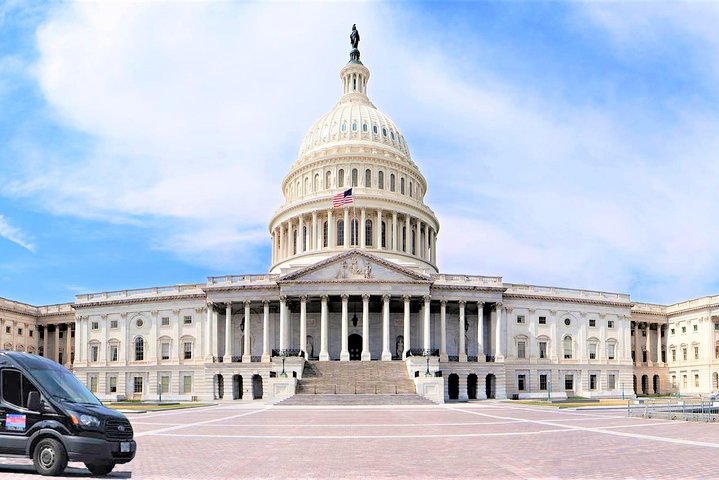
The first stop of our tour will begin at The United States Capitol often called the Capitol Building, is the home of the United States Congress and the seat of the legislative branch of the U.S. federal government. It is located on Capitol Hill at the eastern end of the National Mall in Washington, D.C. Though no longer at the geographic center of the Federal District, the Capitol forms the origin point for the District's street-numbering system and the District's four quadrants.
20 minutes here
Jefferson Memorial
The Jefferson Memorial is a presidential memorial built in Washington, D.C., 1939-1943 Under the sponsorship of President Franklin D. Roosevelt. For Roosevelt it was a suitable memorial to a Founding Father of the United States, and the founder of the Democratic Party. Thomas Jefferson (1743–1826). The neoclassical Memorial building is situated in West Potomac Park on the shore of the Tidal Basin off the Washington Channel of the Potomac River. It was designed by the architect John Russell Pope and built by the Philadelphia contractor John McShain. Construction of the building began in 1939 and was completed in 1943. The bronze statue of Jefferson was added in 1947.
20 minutes here
Martin Luther King, Jr. Memorial
The Martin Luther King Jr. Memorial is located in West Potomac Park next to the National Mall in Washington, D.C., United States. It covers four acres and includes the Stone of Hope, a granite statue of Civil Rights Movement leader Martin Luther King carved by sculptor Lei Yixin. The inspiration for the memorial design is a line from King's "I Have A Dream" speech: "Out of the mountain of despair, a stone of hope." The memorial opened to the public on August 22, 2011, after more than two decades of planning, fund-raising, and construction.
20 minutes here
Lincoln Memorial
The Lincoln Memorial is an American national memorial built to honor the 16th President of the United States, Abraham Lincoln. It is located on the western end of the National Mall in Washington, D.C., across from the Washington Monument. The architect was Henry Bacon; the designer of the primary statue – Abraham Lincoln, 1920 – was Daniel Chester French; the Lincoln statue was carved by the Piccirilli Brothers; and the painter of the interior murals was Jules Guerin. Dedicated in May 1922, it is one of several memorials built to honor an American president. It has always been a major tourist attraction and since the 1930s has been a symbolic center focused on race relations. President Lincoln was the founder of the Republican Party also known as the Grand Old Party (GOP), abolishing slavery in the United States of America.
20 minutes here
The National Archives Museum
The National Archives building holds the original copies of the three main formative documents of the United States and its government: the Declaration of Independence, the Constitution, and the Bill of Rights. These are displayed to the public in the main chamber of the National Archives, which is called the Rotunda for the Charters of Freedom. The building hosts additional important American historical items, including the Articles of Confederation, the Louisiana Purchase Treaty, the Emancipation Proclamation, and collections of photography and other historically and culturally significant American artifacts. An original version of the 1297 Magna Carta confirmed by Edward I is an internationally historical document also on display.
45 minutes here · Admission included
Washington National Cathedral
The Cathedral Church of Saint Peter and Saint Paul in the City and Diocese of Washington, commonly known as Washington National Cathedral, is an American cathedral of the Episcopal Church. The cathedral is located in Washington, D.C., the capital of the United States. The structure is of Neo-Gothic design closely modeled on English Gothic style of the late fourteenth century. It is both the second-largest church building in the United States, and the fourth-tallest structure in Washington, D.C. The cathedral is the seat of both the Presiding Bishop of the Episcopal Church, Michael Bruce Curry, and the bishop of the Diocese of Washington, Mariann Edgar Budde. Over 270,000 people visit the structure annually. The Protestant Episcopal Cathedral Foundation, under the first seven Bishops of Washington, erected the cathedral under a charter passed by the United States Congress on January 6, 1893. Construction began on September 29, 1907, when the foundation stone was laid in the presence of President Theodore Roosevelt and a crowd of more than 20,000, and ended 83 years later when the "final finial" was placed in the presence of President George H. W. Bush in 1990.
25 minutes here · Admission included
Metropolitan African Methodist Episcopal Church
Metropolitan African Methodist Episcopal Church ("Metropolitan AME Church") is a historic church located at 1518 M Street, N.W., in downtown Washington, D.C. It affiliates with the African Methodist Episcopal Church. The congregation was founded in 1838 as Union Bethel (Metropolitan) A. M. E. Church. In 1880, John W. Stevenson was appointed by Bishop Daniel Payne to be pastor of the church for the purpose of building a new church, which would become Metropolitan African Methodist Episcopal Church. The cornerstone was laid in September, 1881. However, Stevenson's methods were upsetting to some of his congregation, and Stevenson was removed before the building was finished after asking for a salary that was deemed too high. The new building was dedicated on May 30, 1886 and was constructed by architect George Dearing. According to the church, it is the oldest continuously black-owned property in the original 10-mile parcel of the District. The funerals of abolitionist Frederick Douglass (1895), the first African American U.S. Senator, Blanche Bruce (1898), and civil-rights activist Rosa Parks (2005) were held in the church. The building was added to the National Register of Historic Places in 1973. In May 2010, the National Trust for Historic Preservation added the building to its list of 11 of America's Most Endangered Places due to water damage and other structural problems requiring $11 million in renovations.
25 minutes here
St. John's Episcopal Church
St. John's Episcopal Church, Lafayette Square is a historic Greek Revival Episcopal church designed by Benjamin Latrobe and located at Sixteenth Street and H Street NW, in Washington, D.C. It is across Lafayette Square from the White House. Every sitting president has attended the church at least once since it was built in 1816, starting with James Madison. With the exception of Richard Nixon, every president since Franklin D. Roosevelt has attended spiritual services on Inauguration Day, many at St. John's. It was designated a National Historic Landmark in 1960
20 minutes here
The White House
The White House is the official residence and workplace of the president of the United States. It is located at 1600 Pennsylvania Avenue NW in Washington, D.C. and has been the residence of every U.S. president since John Adams in 1800. The term "White House" is often used as a metonym for the president and his advisers. The residence was designed by Irish-born architect James Hoban[2] in the neoclassical style. Hoban modeled the building on Leinster House in Dublin, a building which today houses the Oireachtas, the Irish legislature. Construction took place between 1792 and 1800 using Aquia Creek sandstone painted white. When Thomas Jefferson moved into the house in 1801, he (with architect Benjamin Henry Latrobe) added low colonnades on each wing that concealed stables and storage. In 1814, during the War of 1812, the mansion was set ablaze by the British Army in the Burning of Washington, destroying the interior and charring much of the exterior. Reconstruction began almost immediately, and President James Monroe moved into the partially reconstructed Executive Residence in October 1817. Exterior construction continued with the addition of the semi-circular South portico in 1824 and the North portico in 1829.
20 minutes here
New York Avenue Presbyterian Church
The New York Avenue Presbyterian Church in Washington, D.C., is a congregation of the Presbyterian Church (USA). The church was formed in 1859-60 but traces its roots to 1803 as the F Street Associate Reformed Presbyterian Church and another congregation founded in 1820 on its current site, the Second Presbyterian Church. It is located at the intersection of 13th Street and New York Avenue in the city's northwest quadrant, four blocks from the White House. Due to its proximity to the White House, a number of US presidents have attended services there. The F Street Church was established in 1803 with James Laurie as pastor by leaders of the Associate Reformed movement, known as Covenanters, who had seceded from the Church of Scotland in the mother country and retained a separate identity in North America. After holding initial worship services in the U.S. Treasury building, in 1807 the congregation began meeting, still under the leadership of Dr. Laurie, in an imposing brick building that stood where the F Street entrance to the Willard Hotel today opens on to Peacock Alley—just two blocks from the church's present location on New York Avenue between 13th and 14th Streets, NW. The F Street Church, or Willard Hall, was one of the first buildings erected in Washington for Protestant worship.
20 minutes here
Washington Monument
The Washington Monument is an obelisk on the National Mall in Washington, D.C., built to commemorate George Washington, once commander-in-chief of the Continental Army and the first President of the United States. Located almost due east of the Reflecting Pool and the Lincoln Memorial, the monument, made of marble, granite, and bluestone gneiss, is both the world's tallest predominantly stone structure and the world's tallest obelisk,[A] standing 554 feet 7 11⁄32 inches (169.046 m) tall according to the National Geodetic Survey (measured 2013–14) or 555 feet 5 1⁄8 inches (169.294 m) tall according to the National Park Service (measured 1884). It is the tallest monumental column in the world if all are measured above their pedestrian entrances. It was the tallest structure in the world from 1884 to 1889, when it was overtaken by the Eiffel Tower in Paris.
20 minutes here
Museum Of The Bible
The museum contain a different exhibit which emphasizes different aspects of the Bible's history or impact. This includes three permanent exhibit floors, each measuring 55,000 square feet. The first floor combines ancient artifacts with modern technology meant to immerse the participant in the Bible. The front entrance on 4th Street SW features 40-foot (12 meter) tall, 2.5 tonnes (2,500 kg) bronze front doors with stained glass art containing a relief depicting the creation account in Genesis. There is also a grand lobby with a 200-foot (60 meter) LED ceiling allowing for changing visual effects and messages. The second floor focuses on the Bible's impact on world culture, in areas like science, justice, and freedom. Another section is dedicated to the Bible's impact in American history. The third floor presents the general narrative of the Bible from Abraham through the creation of Israel to the ministry of Jesus and the early church. This floor also contains a large Jewish Bible section. The fourth floor presents biblical history and archaeology. Trobisch stated that the museum "will not whitewash conflicts in Christian history but will explain the arguments that were made at the time". The fifth level contains a performing arts theater with a 500-person amphitheater. The museum plans to sponsor scholarly lectures as well as multimedia performances relating to the Bible. The fifth floor also contains separate exhibit space for displays presented by the Israel Antiquities Authority. The sixth floor consists of a rooftop viewing areas overlooking the National Mall and U.S. Capitol, stained glass exhibits, and a ballroom that seats 1,000 guests. The museum's artifact research facility and reference library is located in a one-story addition to the roof of a neighboring office complex.
60 minutes here · Admission included
Where it starts and ends
Meeting point
Washington DC
Cross street is New York Ave. (in front of the White House Gift Shop)
Hotel pickup
No pickup: everyone meets at the start point.
Ends at
400 4th St SW, Washington, DC 20024
Before you book
- Cancellation
- For a full refund, cancel at least 24 hours before the scheduled departure time.
- Languages
- en
- Ticket
- Mobile Only
- Runs on
- Mon, Tue, Wed, Thu, Fri, Sat
- Group size
- Up to 15 travelers per booking
- Operated by
- LIBERTY TOURS DC
Know before you go
- Infants and small children can ride in a pram or stroller
- Service animals allowed
- Public transportation options are available nearby
- Infants are required to sit on an adult’s lap
- Suitable for all physical fitness levels
Photos


Traveler reviews
1 verified traveler reviews for In God We Trust Tour. Ratings and reviews provided by Viator and Tripadvisor.
In God We Trust
Brian was an amazing guide. He was accomodating to what we wanted to see and learn about, very knowledgeable and just delightful to spend to the day with. He interwove Christian beliefs into everything thing that we visited. He connected well with my 13 year old son and made sure to ask him about his knowlege of history and what his opinions were of what we were seeing. I cannot recommend this tour highly enough. Thanks Brian and God Bless!
Response from the operator: Thank you for your wonderful review! We are thrilled too hear about your amazing experience with one of our tour guides. All of our tour guides ensure to give our customers an amazing experience! We hope you book with us again very soon!
via Tripadvisor
Good to know
- Duration
- 6 hours
- Free cancellation
- Up to 24h before
- Minimum age to book
- All ages
- Availability
- Bookable today
- Runs on
- Mon, Tue, Wed, Thu, Fri, Sat
- Hotel pickup
- No pickup, meet at start point
- Booked in 30 days
- 0
- Verdict
- Worth a Look
Who runs this experience
Operated by LIBERTY TOURS DC, who run 4 experiences we rank across 1 city, with an average Outty Ranking of 43.3.
See everything LIBERTY TOURS DC runsWhy this scores 44
The Outty Ranking is a weighted composite. Here is how this experience performed on each component.
In God We Trust Tour: questions travelers ask
Practical detail on this experience, plus the wider planning questions for Washington DC.
How much does In God We Trust Tour cost?
+
Prices start at $440 per person. The final price depends on the date, the time slot and the number of travelers, and peak weekends in Washington DC usually price higher than midweek mornings. Live pricing and remaining availability are confirmed on the booking screen before you pay.
How long does In God We Trust Tour take?
+
Plan for about 6 hours from start to finish, not counting travel to the meeting point. Most travelers leave another 30 minutes on either side so the rest of the day in Washington DC is not rushed.
Is In God We Trust Tour worth it?
+
It holds an Outty Ranking of 44 out of 100, which we label "Worth a Look". That score blends traveler sentiment (5/5 across 1 reviews), the depth of that review evidence, recent booking momentum, value for money against comparable last minute in Washington DC, and how flexible the cancellation terms are.
Can I cancel or reschedule In God We Trust Tour?
+
Yes. Cancel free up to 24 hours before the start time for a full refund. Inside that window the booking is non-refundable, and no-shows are not refunded.
Is In God We Trust Tour suitable for kids and families?
+
Yes, all ages are welcome. Families should still weigh the 6-hour running time, and strollers are easier on the earlier, quieter departures.
How far in advance should I book In God We Trust Tour?
+
Around 0 people booked this in the last 30 days, so popular slots go early. Two to three weeks ahead is comfortable in shoulder season, while summer weekends and holidays in Washington DC can sell out a month out. Same-day spots do open up when other travelers cancel, so it is worth checking if you are already in town.
What should I bring or wear?
+
Bring photo ID, your booking confirmation on your phone, a refillable water bottle and comfortable shoes. Dress for the weather in Washington DC and add a light layer if any part of the 6-hour experience runs outdoors or after sunset.
Where does In God We Trust Tour start and how do I get there?
+
The exact meeting point and directions are on your voucher once you book, and they sit in central Washington DC within reach of public transport. Arrive 15 minutes early: late arrivals are treated as no-shows by most operators.
What are the best things to do in Washington DC?
+
Washington is the rare city where the headline attractions cost nothing and the scarce resource is access. Timed entry to the Smithsonian museums, Capitol and White House tours, and the night monument runs by bike or bus are what fill up. Our ranking rewards operators who secure the passes themselves rather than telling you to sort it out at the door. On Outty we rank every Washington DC experience on the same 0 to 100 scale, and alongside this one the highest scorers right now include Washington DC "See the City" Guided Sightseeing Segway Tour, Arlington Cemetery Small-Group Tour & Changing of the Guards, Washington DC Small-Group Sightseeing Experience. The city page groups everything into most popular, highest reviewed, last minute and family-friendly so you can build a day around what actually delivers.
When is the best time to visit Washington DC?
+
Late March to April for cherry blossom, or September to November for cool museum weather. Booking patterns follow the same curve: prices and queues climb in peak weeks, while shoulder season gives you better availability on the top-ranked experiences and more room to change plans.
How many days do you need in Washington DC?
+
Three full days covers the headline sights without sprinting. A workable rhythm is one anchor experience each morning, such as this one, an unhurried afternoon in a single neighborhood, then a food or nightlife booking in the evening. Five days lets you add a day trip outside the city.
Do I book through Outty or through the operator?
+
Outty ranks and explains the experiences, then hands you to Viator to complete the booking with the operator directly. The price is the same as booking on Viator yourself, and Outty earns an affiliate commission on the referral, which is how the rankings stay free to read.
What is included in In God We Trust Tour?
+
Included: In-vehicle air conditioning. Not included: Lunch. Always check the voucher for the final list before you travel.
Where is the meeting point for In God We Trust Tour?
+
Cross street is New York Ave. (in front of the White House Gift Shop) Hotel pickup is not included, so plan your own transport and arrive 15 minutes early.
What languages is In God We Trust Tour offered in?
+
It runs in English. Pick your language when choosing a date and time, as not every departure runs in every language.
Will I get instant confirmation and a mobile ticket for In God We Trust Tour?
+
Confirmation is sent by the operator after booking, usually within 48 hours; if it is not confirmed you are not charged. Mobile tickets are accepted, so you can show the voucher on your phone.
Is In God We Trust Tour wheelchair or stroller accessible?
+
The operator notes: Infants and small children can ride in a pram or stroller; and Infants are required to sit on an adult’s lap. If accessibility is critical, contact the operator after booking to confirm arrangements for your date.
What happens to In God We Trust Tour if the weather is bad?
+
This experience depends on good weather. If it is canceled because of poor weather, you are offered a different date or a full refund.
Ready to lock in your spot?
Pick a date, choose your group, and see the exact price for In God We Trust Tour.
Pick your date