Baku Day Trip
Traveler rating
Not yet rated
No traveler reviews have been published for this experience yet.
Quick answer
Is Baku Day Trip worth booking?
Baku Day Trip is a 2-hour experience in Baku, Azerbaijan, from $79 per person. It scores 47 out of 100 on the Outty Ranking, which we label “Worth a Look”. Cancellation is free up to 24 hours before the start time. Same-day spots are currently showing.
- Outty Ranking
- 47 / 100
- Rating
- Not yet rated
- Duration
- 2 hours
- From
- $79 per person
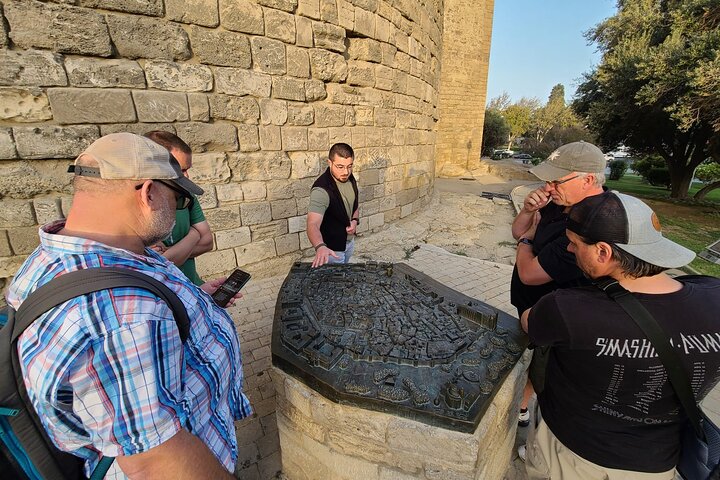
This is a walking tour to discover the reflection of Baku’s past and hear about oil barons of the first oil boom era and their quest for personal glory and fame. The tour offers insider's guide to urban exploration about social, cultural, political aspect of every-day life in Baku with background of stories based on real life of oil barons from late 19th and early 20th century as well as soviet and modern times. The tour highlights how oil changed Baku as as the new generation of the first era of oil boom assumed their social responsibility for a change in an oriental conventional Muslim society. You will hear stories about Azerbaijan’s dilemma of East vs. West, oil barons’ hunger for personal glory and fame, Influence of Polish architects, change and continuity through times under imperial Russia, Soviet and Independent Azerbaijan.
What you get
About this experience
This is a walking tour to discover the reflection of Baku’s past and hear about oil barons of the first oil boom era and their quest for personal glory and fame. The tour offers insider's guide to urban exploration about social, cultural, political aspect of every-day life in Baku with background of stories based on real life of oil barons from late 19th and early 20th century as well as soviet and modern times. The tour highlights how oil changed Baku as as the new generation of the first era of oil boom assumed their social responsibility for a change in an oriental conventional Muslim society. You will hear stories about Azerbaijan’s dilemma of East vs. West, oil barons’ hunger for personal glory and fame, Influence of Polish architects, change and continuity through times under imperial Russia, Soviet and Independent Azerbaijan.
What's included
Included
- Alcoholic beverages
- Bottled water
What you'll see and do
Maiden Tower
The Maiden Tower is a Baku landmark, a much loved symbol of the city and of Azerbaijan. It looms dark and enigmatic, looking out to sea from the southern edge of Baku´s old, walled city, the Icheri Sheher. The origins of the tower are shrouded in mystery - no-one knows for certain when it was built or what it was built for or even how it acquired its name Maiden Tower (Qiz qalasi). No written sources survive that record its construction or original function. Baku historian Sara Ashurbayli calculated that the tower must have been built in the 4th to 6th centuries AD. This was because of the tower’s unusual construction, the difference between the stone used in the tower and the stone of the medieval city surrounding it and the various legends about the Maiden Tower. Another group of researchers think that the tower was built in the 11th century. The reason is the inscription 14 metres high on the south wall of the tower which reads Qubbeye Masud ibn Davud in old Arabic script. Epigraphist Mashadikhanim Nemat studied the inscription and explained the word qübbə as qüllə or tower, so Masud ibn Davud would have been the tower’s architect. The architect of the 14th century Mardakan Tower, Abdulmajid ibn Masud, is thought to be his descendant. However, unlike the Mardakan Tower inscription and another inscription on Sabayil Tower in Baku bay, the Maiden Tower tablet does not include the words Amale ustad or Amale memar (constructor or architect), before Qubbeye Masud ibn Davud. Therefore, the inscription does not necessarily refer to the tower’s architect. The location of the inscription stone, high up the tower, implies that it was placed there accidentally or at least not by the design of the architect. Inscriptions are usually positioned so that they can be read by passers-by, but the Maiden Tower inscription is too high to be seen easily. Historian Bretanitskiy merges both views and say that the tower was built in two stages: in the 5th to 6th centuries and the 12th century. Veliyev links the history of the tower with Zoroastrianism and fire-worship, while Azerbaijani poet Samad Vurgun wrote in his 1960s Epos of Baku that the tower was built 800 years ago.
30 minutes here · Admission included
Starting from the XV century Baku became a capital of Shirvan, one of the most powerful countries in the territory of Azerbaijan. The heads of that country were living in and governing from the Palace. This was the most prominent architectural complex in the medieval city. Walking through the pavilions, courtyards, palace rooms, the crypt, the cistern, the Turkish bathhouses, the mosque, etc., you get a real feel for the every day life within the palace walls. The palace complex consists of nine buildings and each of them was recently restored.
40 minutes here · Admission included
Baku Museum of Miniature Books
The tiny library of books ins the museum is the result of the private collection of Zarifa Salahova, and has been amassed over the period of more than 30 years. In 2002, when she opened the museum, she finally shared her collection with the public. A large portion of the books also stem from the donation of a Ukrainian collector, who presented his petite books to Salahova in 2001. The museum has several thousands of the fairy-sized books, including miniature editions of works of Pushkin, Dostoyevsky, Gogol, and Chukovsky. The books originate from around the world, and are written in numerous languages, including Azeri, Russian, English, and German. The oldest book in the museum is a miniature copy of the Quran, dating to the 17th century, while the smallest tome (6mm x 9mm) is the Russian book “The Most Miraculous Thing,” which can only be read by using a magnifying glass. Salahova, herself a dedicated bibliophile, opened the museum to motivate the next generation of readers to engage with reading and literature. She has also published a few miniature books herself, including the Constitution of Azerbaijan, which is also on display in the museum.
10 minutes here
Palace of Happiness
The Palace of Happiness or Marriage House in Baku has opened its doors to all couples in love after its full reconstruction. The newly reconstructed building has regained its historical looks. The first part of the palace is designed for holding business meetings and official receptions, while the second part - for weddings. The building has an indoor terrace. The building has a solemn ceremonial hall designed in classic style and a VIP reception hall in rococo style, as well as a dancing hall and a waiting room. This enchanting building, the most beautiful architectural pearl of Azerbaijan, was founded by Azerbaijani oil tycoon Murtuza Mukhtarov. It has a very interesting and fascinating history, which could be an inspiration for poets and romantic writers. Feelings materialized in this delicate and elegant palace, which has delighted local people and tourists for more than a century with its beauty and amazing architectural harmony, looking like a castle in fairy tales with its high vaults, stone gargoyles and dragons, languidly sitting in the roof. This is a monument of true love, which has experienced a lot of its characters in its history. The founder of this ``castle`` was very resembling to his mansion. Despite being born to a poor family and not having access to formal education, he managed to become a highly-qualified, self-taught engineer and one of the best specialists in Baku. His enormous experience and shrewdness propelled him into his own business in 1890 when he became the owner of an oil company with two divisions, employing 2,500 workers, which manufactured machinery for derricks and bored new oil wells. The palace was built in 1911-1912 by the Polish architect I. K. Plosko, who designed many architectural buildings in Baku. The building was Mukhtarov`s present to his lovely wife Liza Khanum Taganova, who was astonished by the beauty of a similar building towered up in Venice in the French Gothic style. ``How happy the tenants of this building must be,`` she said looking at the construction in Italy. The palace was designed in French Gothic and Rococo style. Expressive silhouette composition of the house stands out not only in the surrounding buildings, but also in the urban landscape. In 1914, the Mukhtarovs` Palace became the residence of the first Female Moslem Philanthropic Society founded by Liza-Khanum. Together with her husband, she financially supported many of these girls so they could continue their education in Moscow and St. Petersburg. Unfortunately, happy life in the palace ended after the incursion of the Soviet Army in Baku in 1920. A tough period came to Mukhtarovs` life and Mukhtarov`s stand against the revolutionaries ended in inevitable tragic death. Mukhtarov resisted them declaring, ``As long as I`m alive, no barbarian will enter my house in soldier boots.`` Mukhtarov shot all ``undesirable guests` riding horseback through the great halls of his mansion and then killed himself. Liza-Khanum was forced to live in the basement of this very same palace which had been built for her. Deprived of everything she owned, she managed to escape with a diplomat to Istanbul, where she died in 1957. So, the magnificent building built as a sign a great love lost both of its owners... This soaring castle incarnated the love and happy family life. But the destiny of its owners was far from this. The house couldn`t bring mirth to the Mukhtarovs` hearts. But today, young couples link here their bond of love and family, sincerely rejoicing. And each time pieces of happiness absorb to the silent walls of the mansion. Even if Mukhtarov`s ghost wanders about the house, he is happy. If only because his creation brings happiness to people which he did not get.
10 minutes here
The Church of Saviour is a Lutheran church in Baku, Azerbaijan. This church built with donations by parishioner Adolf Eichler and consecrated on March 14, 1899. Currently, it was also used a Ministry of Culture and Tourism concert hall. The Gothic-style church features a portal crowned with a decorated pediment. While Azerbaijan's Evangelical community ceased to exist in 1936, the church survived the Stalinist period because of petitions to Joseph Stalin in which the petitioners promised, in return for sparing the church, to pray for him till death. Nevertheless, Pastor Paul Hamburg and seven other members of the local Lutheran community were executed by firing squad on November 1, 1937.
5 minutes here · Admission included
Saint Gregory the Illuminator's Church
Saint Gregory the Illuminator Church, commonly referred to as the Armenian Church of Baku, is a former Armenian Apostolic church near Fountains Square in central Baku, Azerbaijan.
Pass by without stopping
Where it starts and ends
Meeting point
Baku
Icherisheher
Hotel pickup
No pickup: everyone meets at the start point.
Ends at
Icherisheher
Before you book
- Cancellation
- For a full refund, cancel at least 24 hours before the scheduled departure time.
- Languages
- ru, en, he
- Ticket
- Mobile Only
- Runs on
- Every day
- Group size
- Up to 15 travelers per booking
- Operated by
- Baku Sightseeing
Know before you go
- Wheelchair accessible
- Infants and small children can ride in a pram or stroller
- Service animals allowed
- Public transportation options are available nearby
- Infants are required to sit on an adult’s lap
- Specialized infant seats are available
- Transportation options are wheelchair accessible
- All areas and surfaces are wheelchair accessible
- Suitable for all physical fitness levels
Photos


Good to know
- Duration
- 2 hours
- Free cancellation
- Up to 24h before
- Minimum age to book
- All ages
- Availability
- Bookable today
- Runs on
- Every day
- Hotel pickup
- No pickup, meet at start point
- Booked in 30 days
- 0
- Verdict
- Worth a Look
Why this scores 47
The Outty Ranking is a weighted composite. Here is how this experience performed on each component.
Baku Day Trip: questions travelers ask
Practical detail on this experience, plus the wider planning questions for Baku.
How much does Baku Day Trip cost?
+
Prices start at $79 per person. The final price depends on the date, the time slot and the number of travelers, and peak weekends in Baku usually price higher than midweek mornings. Live pricing and remaining availability are confirmed on the booking screen before you pay.
How long does Baku Day Trip take?
+
Plan for about 2 hours from start to finish, not counting travel to the meeting point. Most travelers leave another 30 minutes on either side so the rest of the day in Baku is not rushed.
Is Baku Day Trip worth it?
+
It holds an Outty Ranking of 47 out of 100, which we label "Worth a Look". That score blends traveler sentiment (0/5 across 0 reviews), the depth of that review evidence, recent booking momentum, value for money against comparable last minute in Baku, and how flexible the cancellation terms are.
Can I cancel or reschedule Baku Day Trip?
+
Yes. Cancel free up to 24 hours before the start time for a full refund. Inside that window the booking is non-refundable, and no-shows are not refunded.
Is Baku Day Trip suitable for kids and families?
+
Yes, all ages are welcome. Families should still weigh the 2-hour running time, and strollers are easier on the earlier, quieter departures.
How far in advance should I book Baku Day Trip?
+
Around 0 people booked this in the last 30 days, so popular slots go early. Two to three weeks ahead is comfortable in shoulder season, while summer weekends and holidays in Baku can sell out a month out. Same-day spots do open up when other travelers cancel, so it is worth checking if you are already in town.
What should I bring or wear?
+
Bring photo ID, your booking confirmation on your phone, a refillable water bottle and comfortable shoes. Dress for the weather in Baku and add a light layer if any part of the 2-hour experience runs outdoors or after sunset.
Where does Baku Day Trip start and how do I get there?
+
The exact meeting point and directions are on your voucher once you book, and they sit in central Baku within reach of public transport. Arrive 15 minutes early: late arrivals are treated as no-shows by most operators.
What are the best things to do in Baku?
+
On Outty we rank every Baku experience on the same 0 to 100 scale, and alongside this one the highest scorers right now include Gobustan and Absheron tour, BEST Gobustan, Volcanoes & Absheron Fire Tour (Group or Private), Shahdag, Quba, Candy Cane - Azerbaijan's Alpine Odyssey Tour. The city page groups everything into most popular, highest reviewed, last minute and family-friendly so you can build a day around what actually delivers.
When is the best time to visit Baku?
+
Booking patterns follow the same curve: prices and queues climb in peak weeks, while shoulder season gives you better availability on the top-ranked experiences and more room to change plans.
How many days do you need in Baku?
+
Three full days covers the headline sights without sprinting. A workable rhythm is one anchor experience each morning, such as this one, an unhurried afternoon in a single neighborhood, then a food or nightlife booking in the evening. Five days lets you add a day trip outside the city.
Do I book through Outty or through the operator?
+
Outty ranks and explains the experiences, then hands you to Viator to complete the booking with the operator directly. The price is the same as booking on Viator yourself, and Outty earns an affiliate commission on the referral, which is how the rankings stay free to read.
What is included in Baku Day Trip?
+
Included: Alcoholic beverages; and Bottled water. Always check the voucher for the final list before you travel.
Where is the meeting point for Baku Day Trip?
+
Icherisheher Hotel pickup is not included, so plan your own transport and arrive 15 minutes early.
What languages is Baku Day Trip offered in?
+
It is offered in Russian, English and Hebrew. Pick your language when choosing a date and time, as not every departure runs in every language.
Will I get instant confirmation and a mobile ticket for Baku Day Trip?
+
Confirmation is sent by the operator after booking, usually within 48 hours; if it is not confirmed you are not charged. Mobile tickets are accepted, so you can show the voucher on your phone.
Is Baku Day Trip wheelchair or stroller accessible?
+
The operator notes: Wheelchair accessible; Infants and small children can ride in a pram or stroller; Infants are required to sit on an adult’s lap; and Specialized infant seats are available. If accessibility is critical, contact the operator after booking to confirm arrangements for your date.
What happens to Baku Day Trip if the weather is bad?
+
This experience depends on good weather. If it is canceled because of poor weather, you are offered a different date or a full refund.
Ready to lock in your spot?
Pick a date, choose your group, and see the exact price for Baku Day Trip.
Pick your date